An Introduction to One of the Most Mysterious Objects in the Universe
The universe is a vast, enigmatic place, filled with wonders that challenge our understanding of space, time, and reality itself. Among its many mysteries, few evoke as much fascination—and fear—as black holes. These cosmic enigmas are often portrayed in science fiction as menacing voids capable of swallowing everything in their path. But what exactly is a black hole? How do they form? And why do they continue to baffle scientists and captivate imaginations?
What is a Black Hole? An Introduction to One of the Most Mysterious Objects in the Universe
In this blog post, we’ll take a deep dive into the incredible world of black holes—exploring their origins, properties, and the mind-bending physics that make them one of the most intriguing phenomena in the cosmos.
1. What is a Black Hole?
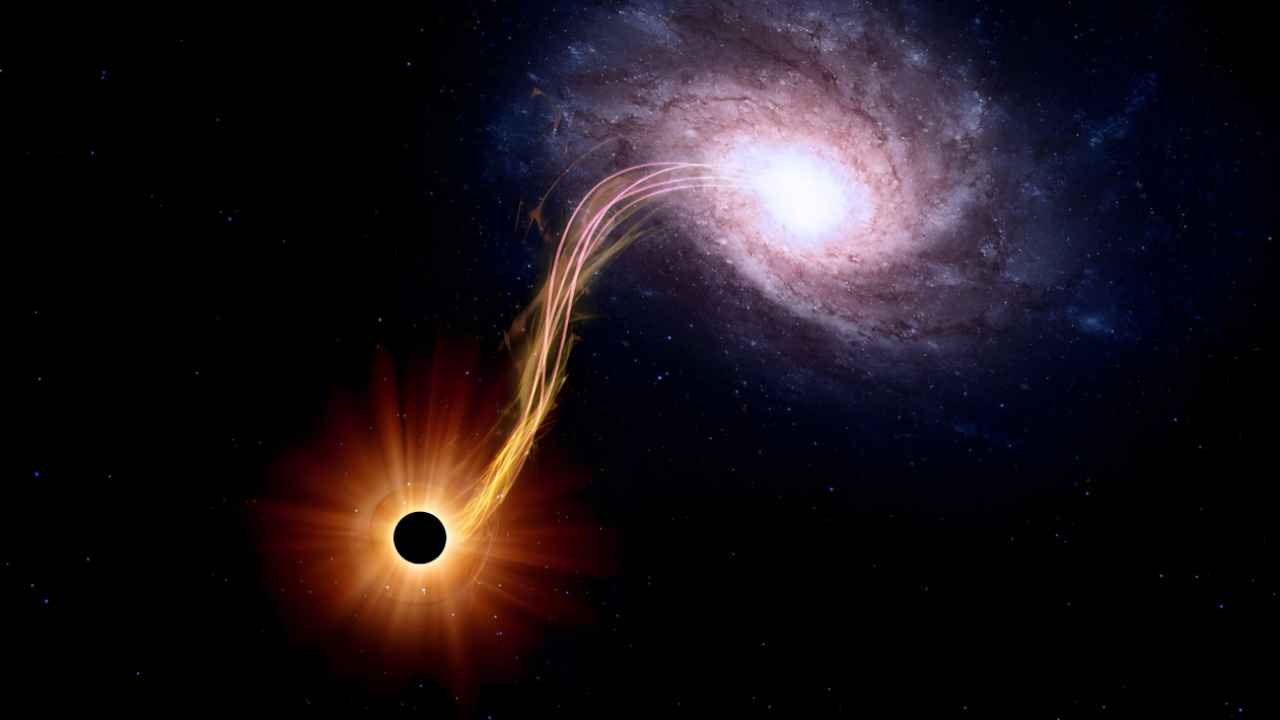
A black hole is a region in space where the gravitational pull is so intense that nothing—not even light—can escape its grip. This is why they are called “black” holes: they emit no light, making them invisible against the backdrop of space.
At the heart of a black hole lies a point called the singularity, where all its mass is concentrated in an infinitely small space. Surrounding this is the event horizon, the “point of no return.” Once any object crosses this boundary, it is inevitably drawn into the singularity.
✦ Key Characteristics:
Immense gravity: Their gravitational force distorts space and time.
Invisible: They can’t be seen directly; we observe them through their effects on nearby matter.
One-way boundary (event horizon): Nothing that crosses it can return.
2. How Do Black Holes Form?
Black holes are not born from nothing—they are the remnants of massive stars that have reached the end of their life cycle.
✦ Stellar Collapse:
When a massive star exhausts its nuclear fuel, it can no longer support itself against gravity. The core collapses, and if the remaining mass is sufficient (typically more than about 2.5 times the mass of our Sun), the core becomes a black hole.
✦ Other Formation Methods:
Merging of neutron stars: Two neutron stars colliding can create a black hole.
Primordial black holes: Hypothetical black holes that may have formed during the early universe.
Supermassive black holes: Found at the centers of galaxies, including our Milky Way. These giants can be millions or billions of times the Sun’s mass, though their origin is still under investigation.
3. Types of Black Holes
Black holes come in different sizes and categories:
| Type | Mass Range | Origin |
|---|---|---|
| Stellar-mass | ~3–100 times the Sun | Collapsing massive stars |
| Intermediate-mass | Hundreds to thousands of solar masses | Possibly from star cluster mergers |
| Supermassive | Millions to billions of solar masses | At galaxy centers; origin debated |
| Primordial (hypothetical) | Micro to planetary mass | Formed soon after the Big Bang |
4. What Happens Inside a Black Hole?
Here’s where things get weird. According to Einstein’s General Theory of Relativity, the intense gravity of a black hole warps space and time around it. Time slows down near the event horizon—a phenomenon known as gravitational time dilation.
Inside the event horizon, all paths lead inward. No known physics can describe what truly happens at the singularity, where density becomes infinite and our laws of science break down. This has led physicists to propose new theories, including quantum gravity and string theory, to resolve these paradoxes.
5. How Do We Detect Black Holes?
Since black holes emit no light, scientists detect them by observing their effects on nearby objects.
✦ Methods of Detection:
Gravitational interactions: Stars orbiting an invisible mass.
X-ray emissions: Matter falling into a black hole heats up and emits X-rays.
Gravitational waves: Ripples in spacetime from black hole mergers, detected by observatories like LIGO and Virgo.
Event Horizon Telescope (EHT): Captured the first image of a black hole’s shadow in 2019.
6. The First Image of a Black Hole
In April 2019, humanity saw the first direct image of a black hole, located in the galaxy M87. The image showed a glowing ring of gas surrounding a dark central region—the black hole’s shadow. This monumental achievement was made possible by the Event Horizon Telescope, a network of radio telescopes around the globe.
This image not only confirmed many theoretical predictions but also symbolized a leap forward in our ability to study these invisible giants.
7. Why Are Black Holes Important?
Black holes aren’t just cosmic vacuum cleaners—they’re crucial to understanding the universe.
Galactic Formation: Supermassive black holes may help regulate star formation and influence the evolution of galaxies.
Testing Physics: They allow us to test the limits of general relativity and quantum mechanics.
Cosmic Laboratories: By studying black holes, scientists explore some of the most extreme environments imaginable.
8. Mind-Bending Theories and Black Hole Paradoxes
✦ Hawking Radiation:
Proposed by physicist Stephen Hawking, this theory suggests black holes can slowly emit radiation and eventually evaporate. This challenges the notion that nothing can escape.
✦ The Information Paradox:
If something falls into a black hole, is the information about it lost forever? This violates quantum mechanics, which insists that information cannot be destroyed. Resolving this paradox remains one of the biggest unsolved problems in physics.
✦ Wormholes and Time Travel:
Theoretical models suggest black holes could be connected to wormholes—shortcuts through spacetime. Could this mean time travel is possible? Maybe—but it’s still deep in the realm of speculation.
9. The Future of Black Hole Research
With advances in technology and astronomy, we are only beginning to unlock the secrets of black holes. Future telescopes, space missions, and particle physics experiments may shed light on their inner workings, help unify quantum theory and gravity, and possibly rewrite the rules of the universe itself.
Conclusion: A Gateway to the Unknown
Black holes are more than just cosmic curiosities—they represent the cutting edge of scientific discovery and the limits of human understanding. They challenge our concepts of space, time, and reality, while offering a glimpse into the deeper laws that govern the universe.
As we peer further into the cosmos, one thing is clear: the mystery of black holes is far from over. In fact, it may only just be beginning.