The Night Paris Lost Its Crown — A Heist Straight Out of Money Heist
Paris — the City of Lights, the city that never loses its charm.
A place where love, art, and history blend into a living masterpiece.
But on the chilly morning of October 19, 2025, Paris woke up not to the rhythm of café chatter and croissants, but to sirens.
Something unthinkable had happened.
Something that made even the most sophisticated security minds in the world whisper in disbelief.
The Louvre — the world’s most secure museum — had been robbed.
Not just robbed of wealth, but robbed of its soul.
It felt like a script ripped straight out of Money Heist.
Four mysterious figures, moving with clockwork precision, breaking into the most guarded building in Europe — and vanishing into thin air before the city even had its morning coffee.
But unlike Netflix fiction, this wasn’t an act, and there was no “Professor” waiting in the shadows.
This was real.
And this time, the target wasn’t cash or gold — it was history itself.
Inside the Louvre lay the treasures of civilization — the Mona Lisa, Egyptian mummies, Greek sculptures, and the sparkling crowns once worn by French emperors and queens.
Each artifact was more than art — it was identity, pride, and memory.
And now, eight of those priceless royal jewels were gone — stolen right under the nose of hundreds of cameras, laser alarms, and guards trained to perfection.
How could anyone breach what was believed to be impenetrable?
How could a fortress of art, science, and culture — watched by millions — lose its heart overnight?
The world wanted answers.
And as investigators peeled layer after layer, they uncovered a plan so flawless, so intelligent, and so cinematic — that it would go down as one of the most audacious heists in modern history.
💎
They didn’t just steal jewels.
They stole centuries of legacy.
And in doing so, they forced Paris — and perhaps the entire world — to question what “security” truly means.
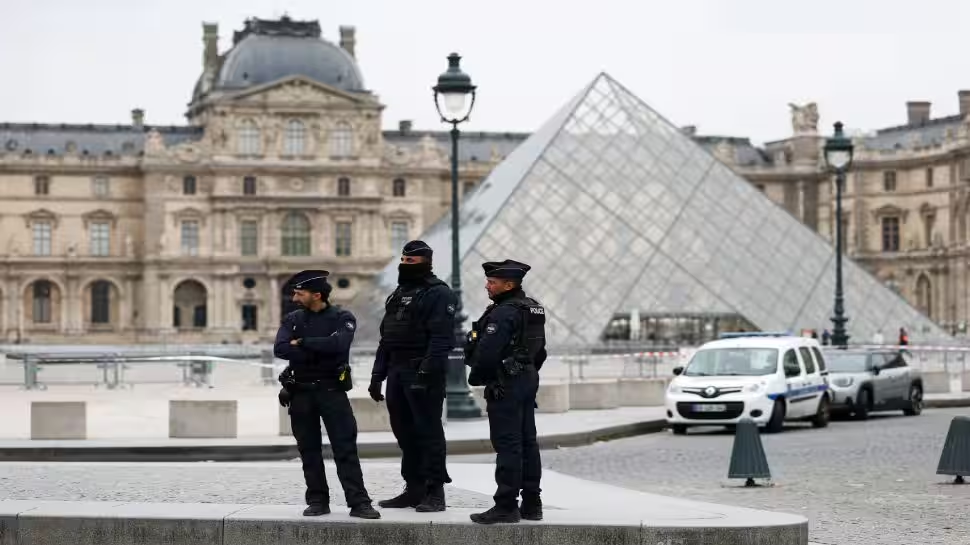
Inside the Fort of Civilization — What Makes the Louvre Untouchable
Before we dive into the heist itself, let’s pause — and step inside the Louvre.
Because to understand the shock the world felt that morning, you must first understand what the Louvre Museum truly is.
This isn’t just a building.
It’s a cathedral of human achievement.
Every wall, every corridor, every silent shadow inside this monument hums with stories that shaped civilizations.
Once upon a time — in the 12th century, King Philip II of France built this place as a fortress to guard Paris from invaders.
Centuries passed.
Kings turned it into a palace, emperors filled it with art, and revolutionaries finally opened it to the people.
In 1793, it became a public museum — a revolutionary act in itself — transforming royal privilege into people’s heritage.
Today, over 10 million people walk through its marble corridors every year.
They come to whisper in front of the Mona Lisa’s mysterious smile, to gaze upon Greek goddesses carved in stone, to stand in silence before the jewels of long-lost empires.
And when they look up, they see the glass pyramid — an architectural miracle — piercing the Parisian sky, reflecting both the old and the new.
But behind the beauty lies an invisible army.
Thousands of cameras watch every corner, motion sensors hum quietly beneath the floors, and alarms wait like sleeping dragons.
Every gallery has its own protection system — glass cases reinforced to military-grade precision.
Security guards in uniforms — and even plain clothes — roam the corridors day and night.
Every staff member is scanned, every delivery inspected, every visitor ticketed and tracked.
Inside the Louvre, the word “flawless” defines both art and security.
It’s said that even a breath too close to the Mona Lisa can trigger an alert.
So the question that stunned the world was simple, and terrifying:
If even the Louvre isn’t safe… what is?
Because when you think of the Louvre, you think of permanence — something untouchable, eternal.
But that illusion shattered like glass on that cold October morning.
Beneath the calm surface of Paris’ proudest institution, a team of silent minds had already mapped every weakness, every blind spot, every timing gap.
They didn’t break in blindly — they studied, waited, and watched.
And when they struck, they didn’t just steal — they performed a masterclass in patience and precision.
In a city that had seen revolutions, wars, and empires rise and fall — the Louvre stood untouched for centuries.
Until that morning, when four unknown figures reminded the world:
Even history can be stolen if you study it well enough.
The Perfect Crime — 4 Thieves, 10 Minutes, and a Vanished Empire
The morning of October 19, 2025, began like any other in Paris.
The streets glowed under soft golden sunlight, cafés were setting out their croissants, and at the Louvre, the day’s first visitors were queuing outside, eager for a glimpse of the Mona Lisa.
No one knew — just a few streets away — a carefully orchestrated ballet of crime was about to unfold.
Around 9:30 AM, as the museum’s massive gates opened, a white truck rolled into the vicinity.
It looked harmless — part of the regular construction activity happening around the Louvre.
Four men stepped out — clad in bright yellow jackets, hard hats, gloves, and dust masks.
They looked exactly like maintenance workers.
No one even turned their head twice.
But beneath that disguise was precision engineering — months of planning, observation, and absolute control.
The team had studied guard rotations, delivery schedules, and blind spots of surveillance cameras for weeks.
And now, it was time to execute.
The truck carried a basket lift — the kind you’d use to clean windows or fix lighting.
The men maneuvered it to the side of the building, where a less-visited maintenance wall met the structure’s upper gallery.
That was their point of entry — a window near the Apollo Gallery, home to France’s crown jewels and royal relics.
They moved with surgical precision.
Using power tools fitted with silencer dampers, they cut through the glass panel of the window.
The camera footage later showed something eerie — not chaos, not fear — but calm coordination.
They weren’t nervous.
They were professionals.
Once inside, they went straight to their target.
No wandering, no confusion — as if they’d memorized every inch of the layout.
In less than seven minutes, they reached the display cases holding the royal jewelry:
The emerald necklace and tiara of Empress Eugénie, wife of Napoleon III.
The sapphire-encrusted tiara of Queen Marie-Amélie.
The necklace and earrings of Empress Marie-Louise.
Each piece, once worn by monarchs, glowed with diamonds, emeralds, and history itself.
They smashed the glass cases with swift, silent precision — no alarms yet, no screams, no resistance.
Within minutes, eight priceless pieces of royal heritage were gone.
Then, just as swiftly, they vanished.
They climbed back through the same window, descended using the lift, and jumped into two waiting motorbikesidling by the wall.
Engines roared — and in seconds, they melted into the chaos of Parisian traffic.
By the time the first alarm blared through the marble corridors of the Louvre, the thieves were already ghosts.
When guards and visitors realized what had happened, disbelief filled the air.
How could anyone breach one of the world’s most guarded museums — in broad daylight — and disappear in ten minutes?
But every heist leaves a shadow.
And so did this one.
Near the wall, police found a broken crown — one of the stolen tiaras had slipped during the escape.
It was the tiara of Empress Eugénie — shattered, glittering in the sunlight, like a broken dream of France’s royal past.
Beside it, investigators found gloves, a helmet, and faint fingerprints.
Tiny clues — but not enough to catch ghosts.
Paris was stunned.
Tourists had filmed the evacuation on their phones, uploading confused videos that went viral within minutes.
“The Louvre has been robbed!” became the global headline of the day.
A real-life Money Heist had just taken place — not on Netflix, but in the beating heart of Europe.
💬
They hadn’t just stolen jewels worth €88 million.
They had stolen France’s pride, identity, and centuries of royal legacy.
And what made it worse — they did it with such grace, such cold precision — that investigators could only admit one thing:
“It wasn’t just a robbery. It was art.”
The Aftermath — Panic, Mystery, and a Trail of Broken Gold
For centuries, the Louvre had stood as a symbol of France’s unshakable pride — the fortress of beauty, culture, and civilization.
But on that cold October morning, that fortress had been breached.
Inside the museum, alarms echoed through marble halls once filled with whispers of admiration.
Guards sprinted in panic.
Visitors — moments ago lost in awe of ancient sculptures — now found themselves herded toward exits under blaring sirens.
The sound of chaos replaced centuries of silence.
Videos began flooding social media — shaky, frantic clips showing tourists running down the grand staircases, clutching their phones.
Some voices trembled, others shouted:
“Did this really happen? Someone robbed the Louvre?”
Within minutes, the museum went into full lockdown.
All exits sealed.
Dozens of police cars surrounded the area, yellow tape cordoning off the world’s most prestigious address.
News vans lined the street outside, journalists shouted into cameras, and the words “Historic Heist in Paris” flashed across every global channel.
The city of lights — stunned into disbelief.
Inside, investigators moved like surgeons through the wounded heart of the Louvre.
The Apollo Gallery — once a shimmering showcase of royal grandeur — now lay shattered.
Broken glass littered the floor like fallen stars.
Empty velvet stands marked the absence of crowns, necklaces, and tiaras once kissed by history.
Forensic experts dusted every inch for prints.
Police found a helmet, gloves, a few tools, and faint DNA traces — the ghosts of the crime.
But the most chilling detail came from security footage:
Four men, calm as monks, moving through the world’s most secure museum
— and leaving with history in their hands.
Within hours, France’s Minister of Culture and Interior Minister arrived at the scene.
The government declared the theft “an attack on national heritage.”
Interpol joined the investigation, suspecting an international art crime syndicate might be involved.
The stolen pieces were declared “priceless” — though experts quietly estimated their worth at €88 million (over ₹900 crores).
But even that number felt hollow.
Because you can’t put a price tag on a crown that once sat on a queen’s head.
You can’t measure the value of time, memory, or civilization.
Then came the darker realization.
This couldn’t have happened without inside help.
Investigators soon learned that several guards had already complained about outdated security systems and short staffing earlier that year.
Some cameras were under maintenance; some alarms were overdue for replacement.
The thieves had known exactly when and where to strike.
Their timing — right as guards were changing shifts and new visitors entering — was flawless.
It wasn’t luck.
It was intelligence.
As the days passed, the Louvre’s grandeur felt hollow.
Visitors stood outside its gates, laying flowers, candles, and handwritten notes — as if mourning a national loss.
Art historians spoke on live TV with tears in their eyes, calling it “the most tragic cultural crime since World War II.”
Social media turned the thieves into urban legends — heroes for some, villains for most.
But for France, it was simple: someone had stolen its heart.
The investigation went global.
Interpol traced leads in Belgium, Italy, and Dubai — whispers of black-market jewel brokers, encrypted auctions, and stolen gems being dismantled to erase their identity.
But each lead ended in silence.
No arrests.
No names.
No jewels.
Just one haunting truth —
the Louvre, for the first time in 800 years, had lost something it might never get back.
And as Paris tried to sleep again, one question kept echoing in the dark corridors of the museum:
“If the guardians of history can’t protect it, who can?”
Legacy of the Heist — When Greed Stole Heritage
In the days that followed, Paris returned to its rhythm — tourists still clicked selfies under the Eiffel Tower, cafés still served espresso with laughter, and street artists still painted love in Montmartre.
But beneath that normalcy, a quiet grief lingered.
Because something sacred had been taken.
The Louvre wasn’t robbed of just diamonds or gold.
It was robbed of its soul — the living link between France’s past and its people.
Experts began comparing the Louvre Heist with two of the most infamous cultural thefts in modern history —
the 1990 Isabella Stewart Gardner Museum heist in Boston,
and the 2019 Green Vault robbery in Dresden, Germany.
Both crimes had one chilling thing in common: the stolen artifacts were never found.
Vanished forever.
Lost not to time, but to human greed.
And now, Paris feared it had joined that cursed list.
In press conferences, officials vowed to recover the jewels “no matter how long it takes.”
Interpol expanded its surveillance of black-market trading rings, scanning the dark web for whispers of emeralds, sapphires, or diamonds matching royal French design.
But the truth was sobering — such treasures rarely reappear.
Because when thieves realize they can’t sell history as it is, they destroy it.
They tear the jewels apart, melting the gold, breaking the stones, scattering them across secret markets — erasing centuries of culture in minutes of greed.
And that, Guruji, is the real tragedy of modern times.
For most people, this story is a headline — a thrilling “real-life Money Heist.”
But for those who understand heritage, it’s something far deeper.
It’s a warning — a reminder that even the strongest walls and sharpest technologies cannot defend a civilization if its people forget to value what’s inside.
Security systems can protect buildings.
But only integrity can protect legacy.
Maybe someday, a museum curator or a historian will stumble upon one of those missing jewels — hidden in a dusty collection, or offered quietly at an auction.
Maybe they’ll be returned to their glass cases, where they belong.
Or maybe, like so many stolen treasures, they’ll remain whispers in the dark — their brilliance dimmed, their stories untold.
But one thing will always remain: the lesson.
That the greatest theft is not of jewels or gold —
but of history itself.
And as Paris glows again at night, under the same moon that once shone on emperors and queens, the Louvre still stands tall — a little more wounded, a little more watchful.
Its glass pyramid reflects a silent truth:
civilizations aren’t lost in wars —
they’re lost when greed becomes smarter than gratitude.
💭 Final Thought:
Every generation inherits more than monuments.
We inherit responsibility — to protect beauty, memory, and meaning.
Because once history is stolen, no ransom can buy it back.
✨ Tandav Coach – Acharya Sunil Chaudhari 🔱
✨ India’s Only Digital Success Coach with Full Support 💻
✨ Founder – JustBaazaar & Career Building School 🏢
✨ Author – “Power of Thoughtful Action” 📘
✨ Top Digital Marketing Expert & Best SEO Expert in India 🌐
✨ #TandavShow | #KootNeeti 🔥🇮🇳